
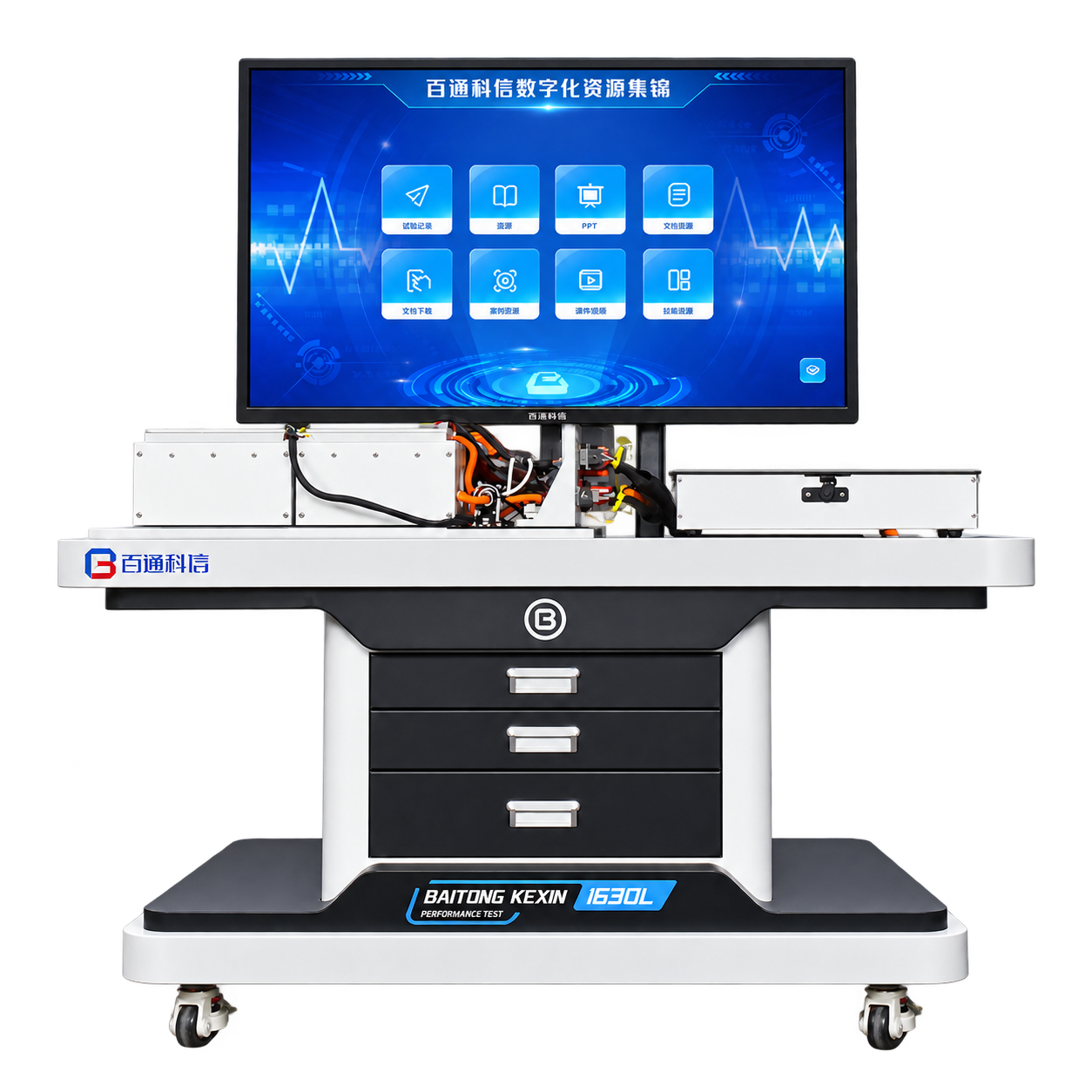
EV Battery Performance Test & Analysis Platform
Model: BT-NEV2-T068
A battery test station for programmable charge-discharge cycles, capacity measurement and DC internal resistance analysis.
- Charge Voltage
- 0–100 V DC
- Discharge Voltage
- 10–100 V DC
- Channel Current
- −30 to +30 A
- Workstation dimensions
- ≥1,630 × 780 × 1,730 mm (L × W × H)
On This Page Overview
Product Overview
A battery test station for programmable charge-discharge cycles, capacity measurement and DC internal resistance analysis.
Core Functions
The platform connects battery-performance principles with controlled test procedures and recorded results. Learners can prepare a test, monitor voltage, current and temperature information, and review how measured behavior changes under instructor-defined conditions.
Practical Training Tasks
- Controlled battery performance test
- Traction-battery testing
- Performance-test software operation
- System test
- Fault-box practice
- Battery performance experiment
- DC internal resistance (DCIR) test
- Complete-vehicle traction-battery test
- Battery-management system (BMS) measurement
- Traction-battery fault diagnosis and service inspection
- Traction-battery experiment
Equipment and Test System
Traction-battery test bench frame
Traction battery
Traction-battery test system
Performance-test software
Fault-box practice
All-in-one teaching display
Technical Specifications
Values describe the reference configuration. Cell ratings are not complete-pack ratings, and the BMS supply is not the station input. Confirm pack wiring, permitted test limits, final dimensions and installation requirements in the quotation.
The following values define the verified configuration. Symbols such as ≥, ≤ and < retain their specified meaning.
| Workstation dimensions | ≥1,630 × 780 × 1,730 mm (L × W × H) |
|---|---|
| Rated power | ≤4 kW |
| Working supply | 380 V AC ±15%, three-phase five-wire; 50 Hz ±5 Hz |
| Charging-voltage range | 0–100 V |
| Discharging-voltage range | 10–100 V |
| Current range | 0 to ±30 A |
| Voltage measurement and control accuracy | 0.05% FS + 0.05% RD |
| Output-voltage resolution | ≤0.05% FSR |
| Single-channel output-current range | -30–30 A |
| Current measurement and control accuracy | 0.05% FS + 0.05% RD |
| Output-current resolution | ≤0.05% FSR |
| Output-voltage ripple | ≤0.5% FSR |
| Sampling interval | ≤10 ms |
| Minimum step time | ≤100 ms |
| System energy-feedback efficiency | ≥80% |
| Operating system | Windows |
| Teaching-display size | 55 in |
| Memory configuration | 8 GB + 512 GB |
| Processor | i5 |
| BMS operating voltage range | 9–36 V DC |
| BMS operating temperature range | -40–85 °C |
| BMS storage temperature range | -40–125 °C |
| BMS operating humidity | 0–95% |
| Cell-voltage detection range | 0–5 V |
| Cell-voltage sampling accuracy | ≤5 mV |
| Cell-voltage sampling interval | ≤100 ms |
| Total-voltage detection accuracy | <1% |
| Temperature measurement range | -40–125 °C |
| Temperature detection accuracy | ±1 °C |
| Current detection range | ≤75 A |
| Cell voltage | 3.2 V |
| Cell capacity | 30 Ah |
| Temperature-sensor resistance at room temperature | 1,000 Ω |
| High-voltage relay contact-current rating | 0–500 A |
| High-voltage relay coil voltage | 9–36 V |
| High-voltage relay maximum operating voltage | 0–2,200 V |
| Precharge resistance | 100 Ω |
| Precharge-resistor power | 100 W |
Configuration and Ordering
Reference Laboratory Quantity
1 unit
This quantity belongs to the reference laboratory equipment schedule. Confirm the quantity for your project in the quotation.
Configuration and Procurement
Confirm the final battery configuration, test range, channels, instrumentation, software version, room services and installation responsibilities in the signed technical schedule. The destination electrical supply and battery-safety provisions should be reviewed before ordering.
Details for Your Inquiry
Share the learner level, class size, planned battery tests and destination electrical conditions so the test range, equipment scope, software and applicable safety procedures can be defined for the project.
Product Questions
Which battery tests are covered?
The configured scope includes controlled charge-discharge testing, DC internal-resistance work, BMS measurement and review of voltage, current and temperature data within the specified range.
How does this differ from the battery assembly system?
This platform focuses on repeatable performance testing and data analysis. The battery assembly system is intended for cell inspection, module and pack assembly, commissioning and guided circuit diagnosis.
Can a different battery be connected?
Compatibility depends on the battery chemistry, voltage, current, communication and safety requirements. Any alternative test object must be documented in the signed technical schedule.
What should be reviewed before installation?
Review the three-phase electrical supply, battery-handling procedure, room conditions, test range, software configuration, installation scope and instructor operating requirements.
Continue Exploring
Related Products
Compare the stated teaching roles below. Product connections, included accessories and software licenses are confirmed in the selected configuration.