
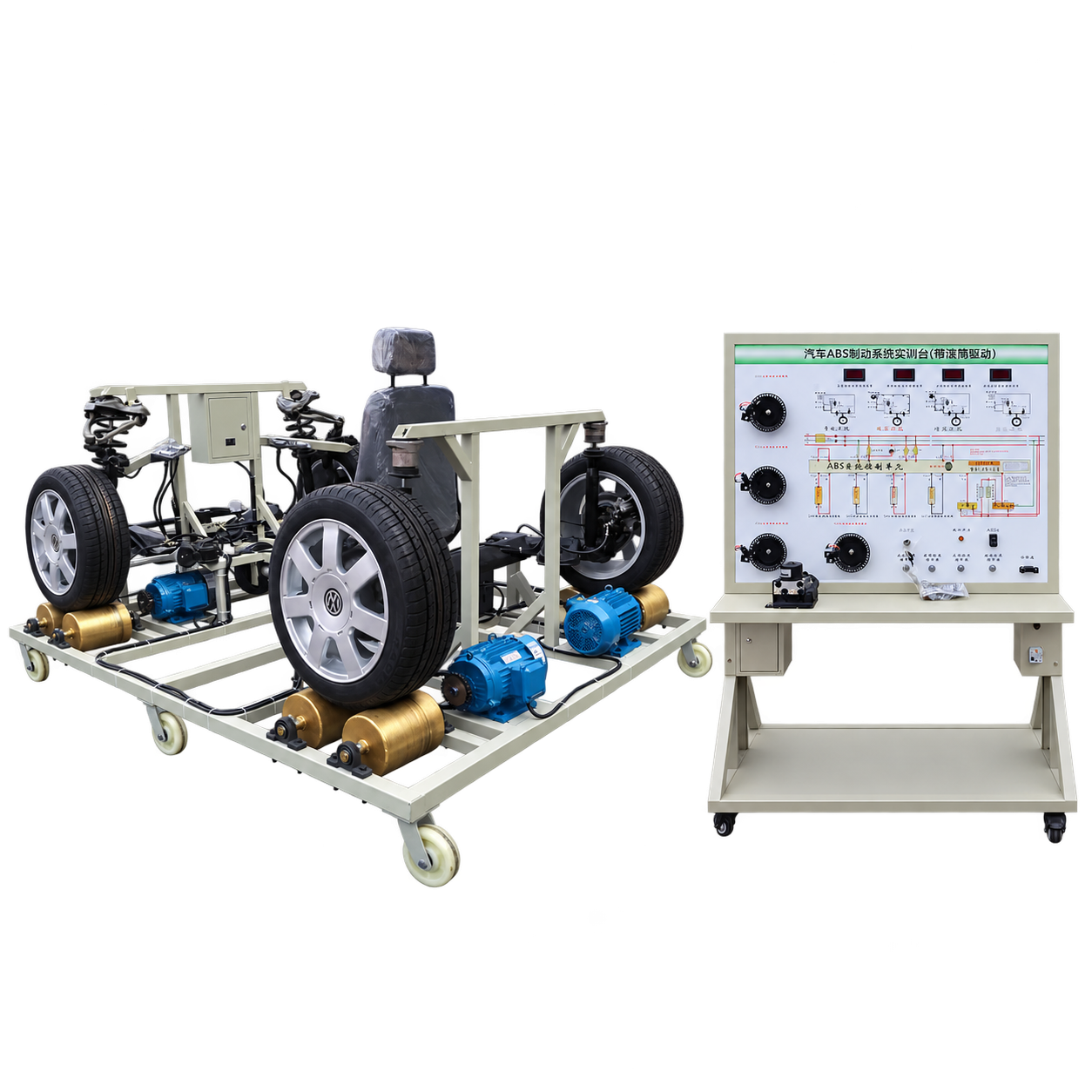
ABS Training Bench
An automotive teaching bench for anti-lock braking system (ABS) principles and control relationships.
- Teaching Focus 1
- Anti-lock Braking Principles
- Teaching Focus 2
- Explain an Intervention Scenario
On This Page Overview
Product Overview
The Baitongkexin ABS Training Bench is intended for brake-control courses that explain why anti-lock intervention is needed and how the system relates to conventional braking. Teaching can connect wheel-behavior information with control decisions at a conceptual level. Choose the practical configuration according to whether the course needs component recognition, circuit study or a supervised operating demonstration.
Course Focus
Anti-lock Braking Principles
Explain how conventional braking and anti-lock intervention address different conditions. Students can relate wheel-behavior information to control decisions using the configuration's actual diagrams or demonstration method; no road-performance result is implied.
Explain an Intervention Scenario
Start from ordinary brake operation and introduce a conceptual wheel-behavior condition in which anti-lock control becomes relevant. Relate the available inputs and controlled elements in the quoted configuration to that decision, without equating a bench demonstration to vehicle-road performance.
Assess the Control Explanation
A student should state what information is needed, what response is expected and which documented observation would support the explanation. Where the unit lacks live signals, use approved diagrams or scenario data as teaching material, clearly identified as such.
Practical Training Tasks
Braking comparison
Learner Practice
Compare ordinary braking with an anti-lock intervention scenario.
Evidence for Review
Explanation of ordinary and anti-lock cases
ABS information
Learner Practice
Identify the inputs and controlled elements documented for this trainer.
Evidence for Review
Map of documented inputs and controlled elements
Warning scenario
Learner Practice
Explain a diagnostic route for a stated ABS warning.
Evidence for Review
Diagnostic plan that states needed evidence
Configuration and Ordering
Configuration and Procurement
Specify the brake assembly, electronic control components, method of demonstrating wheel signals and supported diagnostic access. A static teaching display and an operating bench support different tasks.
Details for Your Inquiry
Tell us the ABS system and practical tasks your learners need. Request confirmation of the sensing, control and demonstration arrangements before finalizing the course equipment.
Product Questions
What is the difference between an ABS bench and a braking-system bench?
The ABS entry focuses on anti-lock control principles. The separate braking bench is suited to the conventional brake layout and service path. Check the actual hardware on both before assigning practical exercises.
What could students explain after the lesson?
They should be able to distinguish ordinary braking from a scenario requiring anti-lock intervention and identify the documented information the controller uses. This does not amount to a verified braking-performance test.
Can fault diagnosis be practiced?
Only if the selected bench supplies the required control unit, interfaces, diagrams and any approved fault method. A conceptual diagnosis exercise can use documented symptoms without claiming physical fault insertion.
What should be confirmed for an operating demonstration?
Ask how wheel signals and braking actions are represented, what moves or pressurizes, and what guarding and instructor controls are provided.
Can this bench reproduce real road braking?
The current list does not specify its operating arrangement or test conditions. Confirm the demonstration method and limitations before describing road-like behavior.
Continue Exploring
Related Products
Compare the stated teaching roles below. Product connections, included accessories and software licenses are confirmed in the selected configuration.