

Asia · Vietnam Market Guide
EV Training Equipment in Vietnam: A Practical Lab Planning Guide
Choose battery, motor and charging systems around local teaching needs, practical skills and a workable procurement plan.
On This Page
The planning answer
What should an EV training lab in Vietnam include?
A practical EV training lab in Vietnam should connect electrical fundamentals, battery and BMS diagnosis, motor inspection, charging-system training and supervised vehicle work. Select equipment around observable student tasks, the vehicles used by local employers and the practical time each learner receives. Vietnamese teaching resources, instructor preparation and a clear acceptance plan belong in the initial specification.
For most colleges, the strongest first investment is a teachable sequence: protected electrical practice, component-level measurement, documented diagnosis and assessment. Add specialist performance testing when the course, site and instructors can use it. A passenger-car training platform can explain transferable EV principles, but its compatibility with electric motorcycles or a particular vehicle brand must be verified separately.
1. Vietnam’s EV opportunity is a skills question
For a Vietnamese college buying automotive training equipment, the useful question is which service and diagnostic tasks graduates will perform. Vehicle sales alone cannot define the curriculum. A battery assembly station, a motor test bench and a charging trainer each solve a different teaching problem.
The World Bank’s November 2024 roadmap identifies workforce development as one of five foundations of Vietnam’s electric-mobility transition. It also expects two-wheelers to remain the leading form of private mobility through 2035. Use these planning signals to test which skills the curriculum should prioritise. [1]
A separate employer signal comes from Vingroup’s October 2025 announcement of a VinFast recruitment and training programme covering 2,000 electric-car technicians and 1,200 electric-motorcycle technicians. The announcement described a programme being rolled out; it did not report that all 3,200 people had already completed training. [2]
Our planning interpretation: combine transferable electrical diagnosis with clearly separated vehicle-specific practice. Ask nearby employers which diagnostic evidence they expect a new technician to produce, then build the equipment schedule around those requirements.
2. Match the lab to its Vietnamese catchment
A laboratory in Hanoi should not automatically receive the same configuration as a centre serving agricultural maintenance learners around Can Tho. Begin with the institution’s placement partners, learner intake and workshop access. Use the regional options below to organise employer interviews and course planning; they are proposed starting points, rather than market-size rankings.
| Location / catchment | Question to validate locally | Potential teaching emphasis |
|---|---|---|
| Hanoi & Hai Phong | Which vehicle-service or manufacturing employers will provide practical tasks and placement feedback? | Battery/BMS measurement, motor assembly inspection and diagnostic records. |
| Ho Chi Minh City & Dong Nai | Will graduates join car workshops, two-wheeler service businesses or mixed fleets? | Electrical fundamentals, charging-state diagnosis and vehicle-specific service practice. |
| Da Nang & central Vietnam | Would shared facilities serve several colleges or short upskilling courses? | Modular stations, repeatable fault cases and instructor development. |
| Can Tho & the Mekong Delta | Does the programme include agricultural machinery maintenance alongside automotive subjects? | A separate mechanical, hydraulic and harvesting-equipment teaching track. |
Hai Phong is directly relevant to the employer example: Vingroup names its VinFast factory and service workshops as training locations. [2] For every region, interview placement supervisors before deciding how much of the budget belongs in car systems, two-wheelers or agricultural machinery. Geography should change the brief, not just the page title.
3. Write the assessment before the equipment list
Replace broad outcomes such as “understand new energy vehicles” with tasks an instructor can observe. A learner might identify battery components, compare a permitted measurement with BMS data, explain a charging-state mismatch or document why a motor assembly is ready for the next inspection stage.
For each task, record the learner’s starting level, required tools, permitted operating conditions, supervision and evidence of success. A first-year electrical course and an experienced-technician upskilling course may need different access to the same system. A demonstration that is suitable for a full class may still be unsuitable for individual practical assessment.
Ask employers to review a short sample assessment. Would a graduate’s worksheet help a workshop supervisor understand the symptom, test selection, measured evidence and conclusion? If the answer is no, improve the task before adding a more elaborate trainer. BTKX’s curriculum and course development service is a relevant starting point for discussing how equipment and task materials can be matched.
4. Make battery and BMS lessons evidence-based
The BT-NEV2-T028 EV Battery Assembly & BMS Training System connects LFP battery assembly, measurement instruments, a manual fault-setting interface and BMS monitoring software. Its documented teaching tasks include cell-voltage and internal-resistance measurement, component inspection, pack assembly and instructor-selected electrical fault diagnosis.
For a Vietnamese training programme, its value lies in asking learners to reconcile physical evidence with displayed data. A useful exercise produces a measurement record, a comparison with BMS information and an explanation of the suspected circuit or component. Reading a screen without explaining the evidence is a weaker outcome.
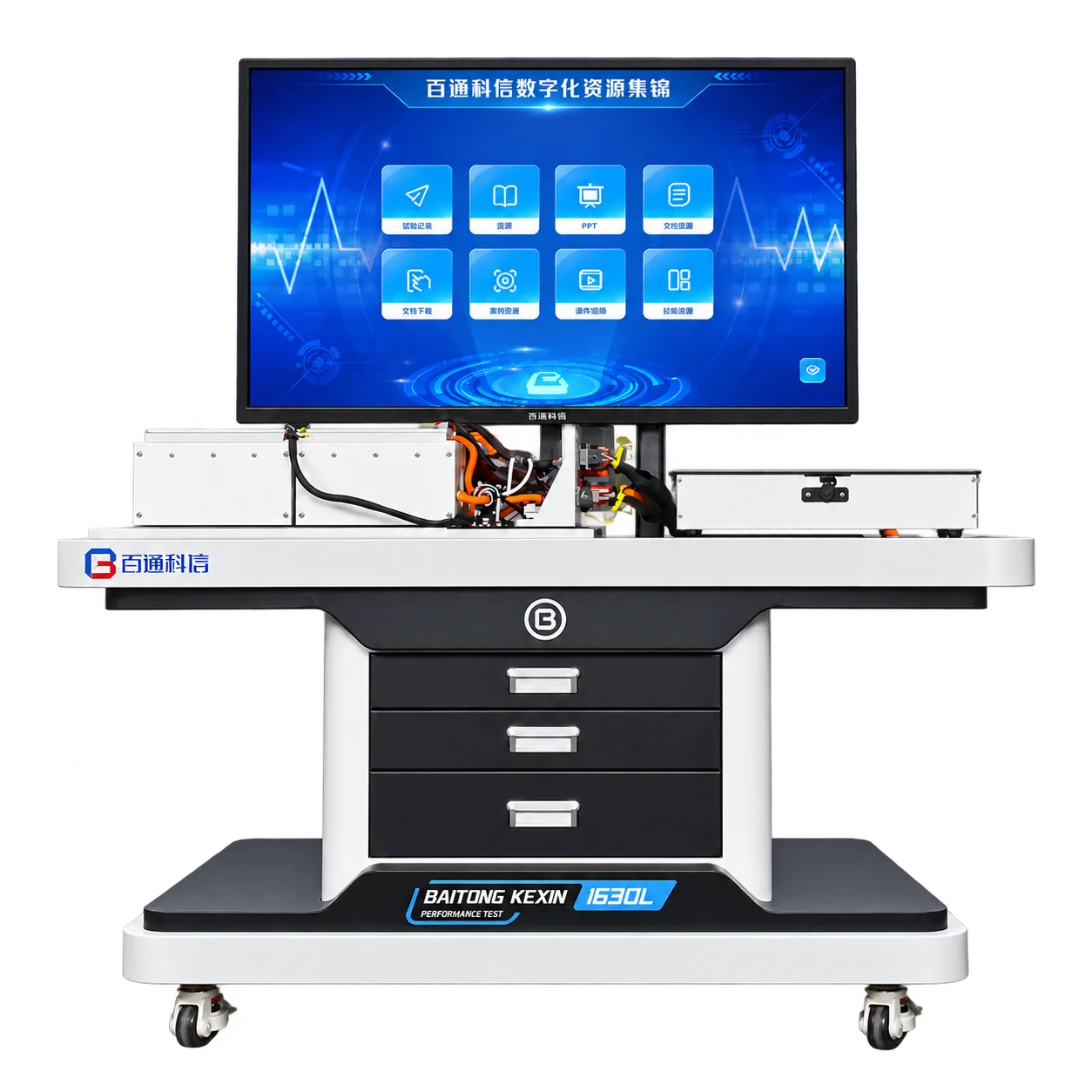
The current product page lists a nominal battery voltage of ≥60 V and 3.2 V / 30 Ah LFP cells. These are model-specific catalogue values, not evidence of compatibility with every Vietnamese vehicle. Confirm battery chemistry, voltage, diagnostic interfaces and approved exercises against the intended course.
Also separate assembly teaching from extended battery performance analysis. If the syllabus needs sustained cycling or performance-data analysis, review a dedicated performance platform with BTKX. Do not assume those functions are included because the workstation can support documented charge-discharge tasks.
5. Separate motor assembly from motor performance
An EV motor training bench should be selected for a defined job. BTKX distinguishes the T036 motor assembly and testing platform from the T076 motor performance test platform. Assembly, resolver alignment and dimensional checks are different from instrumented operating-performance tests.
A useful course connects the two through inspection records. Learners explain assembly quality before interpreting torque and speed results. The assessment should reward traceable measurements and a justified decision about readiness, rather than completion of an assembly alone.
This distinction matters when comparing quotations. One supplier may quote an accessible assembly unit while another includes a load system and performance instrumentation. The prices describe different teaching capacity. For the documented T076 configuration, BTKX specifies a 380 V AC three-phase five-wire supply; the site engineer must check the actual ordered requirement. The selected motor, controller, coupling and load must also be confirmed as a compatible set.
Use the drive motor training application to define the task sequence, then request the technical schedule for the chosen configuration.
6. Teach charging diagnosis at the right scale
EV charging training equipment should help learners explain why a charging sequence starts, stops or fails. Component recognition, documented circuit inspection, pilot-state interpretation and protection-response evidence are useful teaching outcomes. Owning a large charger does not by itself create a good course.
BTKX’s T040 AC charging assembly platform supports charging-component assembly and guided circuit checks. The charging infrastructure training application describes a reference teaching charger rated at ≤1.5 kW and ≤7 A. Those limits describe teaching hardware; they should not be presented as commercial fast-charging capacity.
For Vietnam, identify the connector, pilot protocol and target vehicle before ordering. A station developed around one interface cannot be assumed to match every local EV. Request a demonstration of the exact teaching interface and an agreed example of a charging-state diagnosis task.
Keep educational equipment acceptance separate from approval to install commercial charging infrastructure. If a programme needs DC fast-charging, charge-point operator software or site commissioning competencies, define these as additional scopes with their own hardware, training and acceptance requirements.
7. Preserve the bridge from conventional vehicles
Vietnamese institutions do not need to discard an existing automotive curriculum to introduce EV teaching. Wiring interpretation, sensor evidence, mechanical inspection, steering, suspension and disciplined fault diagnosis remain useful foundations. Audit the existing workshop first so new purchases address genuine teaching gaps.
BTKX’s conventional vehicle training equipment covers engine, transmission, chassis and electrical subjects. A college can connect these courses to EV-specific battery, motor and charging modules while maintaining clear differences between propulsion systems.
The same care applies to electric motorcycles. General battery and motor principles may transfer, but pack construction, controllers, connectors, vehicle data and service procedures can differ. Require model-specific practice or a validated adaptation where the employment objective is two-wheeler service. A passenger-car platform should never be described as a complete electric-motorcycle maintenance solution without supporting evidence.
8. Give agricultural programmes their own track
For institutions whose local employer interviews identify agricultural maintenance needs, an automotive-only laboratory may leave an important teaching gap. A separate track can focus on mechanisms, power transmission, hydraulics and field-machine adjustment. Its equipment and assessments should follow the actual machinery learners will encounter.
BTKX’s agricultural machinery training range includes rice-transplanter, tractor power-system and harvesting teaching platforms. Use local employer interviews to decide which modules merit inclusion and identify the machines needed for complementary field practice.
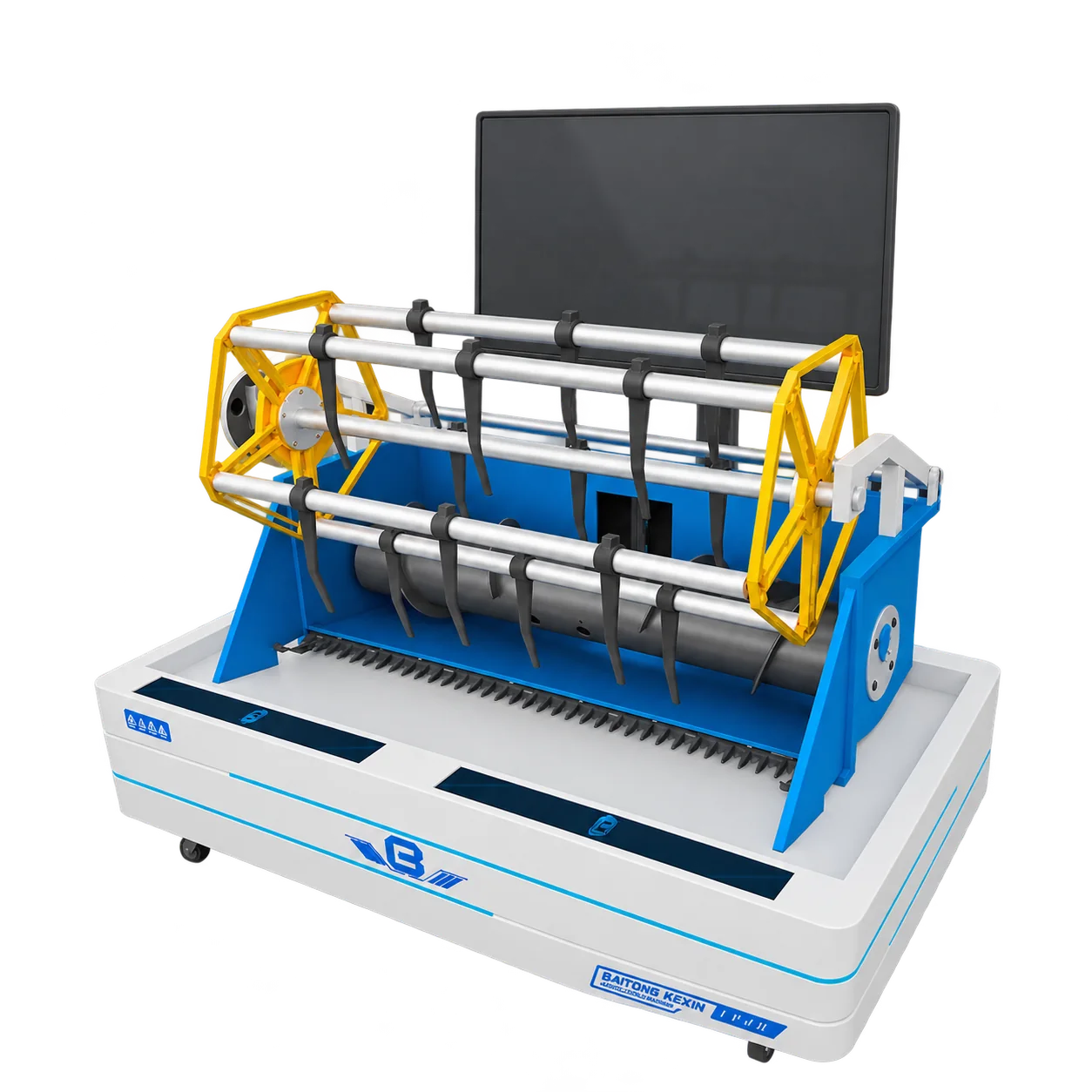
An indoor header trainer can make moving mechanisms visible for guided study. It does not replace field operation or prove competence on every combine model. Define which adjustment, inspection and explanation tasks belong indoors and which require supervised access to real machines through a local partner.
9. Connect each equipment family to a deliverable
A procurement matrix makes supplier comparisons more useful. It also prevents several products from being credited with the same learning outcome while another course has no practical equipment at all. The following is a proposed teaching map, not a fixed package or a promise that every accessory is included.
| Teaching block | BTKX equipment / route | Student evidence to request |
|---|---|---|
| Battery & BMS | T028 battery assembly system | Measurement sheet, BMS comparison and a supported diagnostic conclusion. |
| Drive motor | T036 assembly; compatible T076 performance station if needed | Assembly inspection record; separately defined performance-test interpretation. |
| AC charging | T040 and the confirmed interface / test configuration | Component inspection and documented charging-state response. |
| Vehicle diagnosis | Vehicle fault-diagnosis application | Model-specific symptom, evidence, diagnosis and verification report. |
| Digital preparation | Physical and virtual training resources | Preparation record followed by individually observed physical practice. |
Add the task duration, group size and instrument list beside each row in the institution’s working version. That document becomes a bridge between the syllabus, floor plan, supplier quotation and final acceptance demonstration.
10. Plan the room around supervision and access
A usable EV training laboratory in Vietnam needs more than a floor-area figure. Survey entrances, crate access, equipment movement, power distribution, protective systems, ventilation, storage and instructor sightlines. The institution’s competent specialists should define the site provisions and permitted teaching conditions for the selected equipment.
Separate discussion and documentation from activities needing controlled access. Allocate space for tools and instruments so a practical lesson does not depend on searching for shared accessories. A battery workstation’s catalogue footprint is not the complete working envelope once learner access, maintenance and movement are considered.
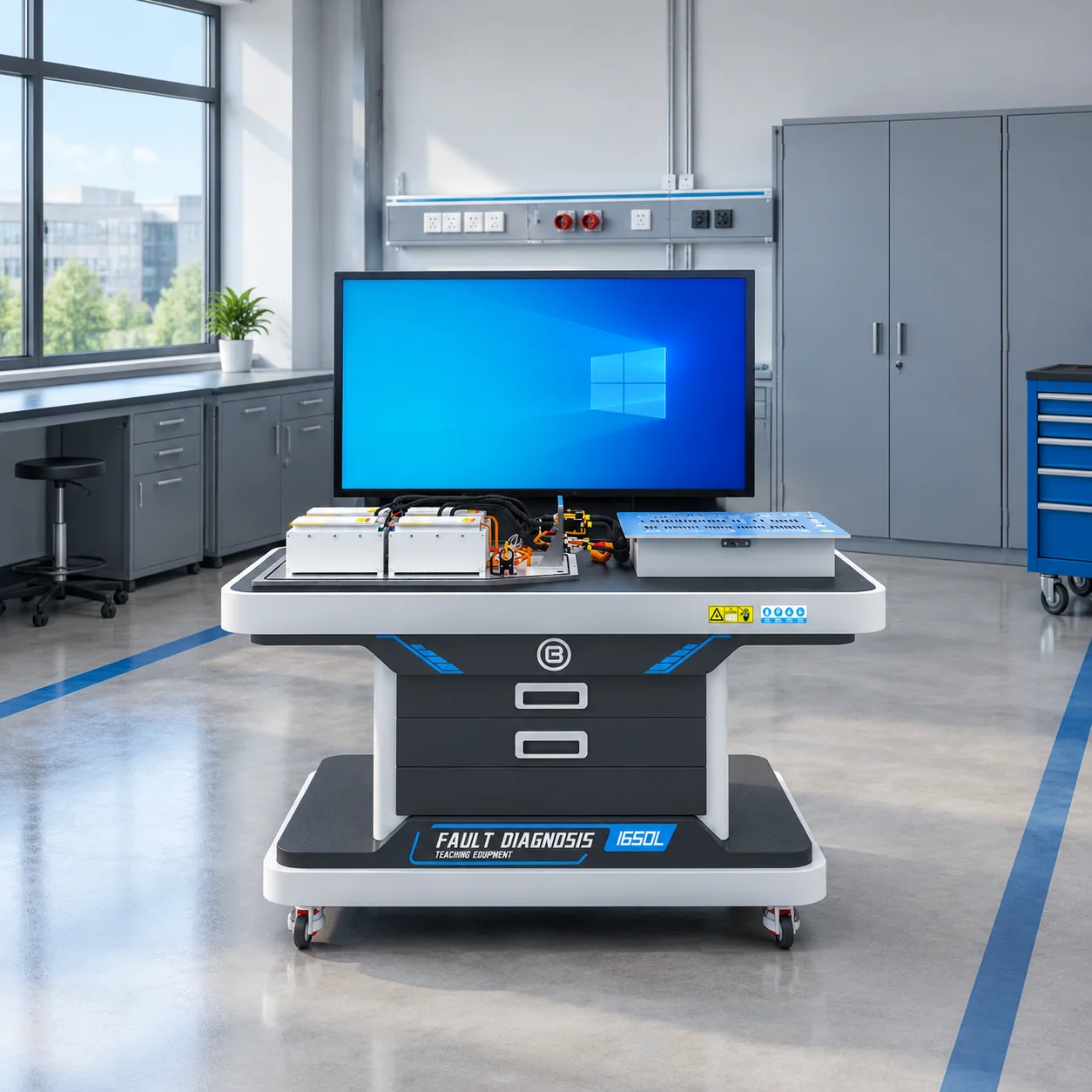
Where humidity, dust, flood exposure or power interruptions are concerns at the proposed site, document them in the brief and ask how storage, maintenance and equipment selection should respond. Do not treat one component’s ingress or environmental rating as a rating for the entire workstation. BTKX’s EV lab planning service can be discussed alongside the institution’s site survey.
11. Calculate hands-on time before buying duplicates
Consider an illustrative class of 24 learners, split into four groups of six for a two-hour session. Four 30-minute rotations can connect instructor-supported physical work, component recognition, simulation and evidence review. This is a scheduling example, not a recommended safe group size or an equipment-capacity claim.
Review the task and expected evidence.
Complete the permitted physical activity.
Compare measurements and system data.
Submit and discuss the diagnostic record.
With one physical station and one group at a time, each group receives only one 30-minute slot. That does not mean every learner gets 30 minutes of personal operation. If only one learner can perform the assessed activity at once, six learners share that slot. Instructor demonstration, reset and documentation reduce available operating time further.
Use this arithmetic to choose station quantities and timetable length. If a single physical activity requires 12 minutes per learner, 24 learners require 288 learner-minutes. Two stations running continuously for 120 minutes provide only 240 station-minutes before changeovers. Simulation can prepare learners efficiently, but it cannot erase the remaining physical-assessment requirement.
12. Localise the teaching system, not just the interface
An English-language equipment catalogue may support international procurement, while classroom success depends on resources instructors and learners can use confidently. Define the required Vietnamese task sheets, terminology, diagrams, software language and assessment materials in the quotation. Availability should be confirmed; a market page is not evidence that a Vietnamese software version already exists.
Ask a Vietnamese instructor to review a sample lesson before finalising translation. Important terms should remain consistent across the display, wiring diagram, worksheet and assessment rubric. A bilingual glossary can connect Vietnamese teaching terms with the English labels learners may encounter in technical documentation.
Instructor preparation should include setting up a lesson, selecting approved faults, resetting the station, interpreting student evidence and maintaining the delivered equipment. Request a teach-back demonstration: the college instructor runs the agreed task while the supplier checks understanding. Discuss the available delivery formats through BTKX teacher training programmes, with language, location and support responsibilities confirmed separately.
GIZ’s TVET reform work in Vietnam emphasises cooperation between vocational institutions and business and the development of green and digital skills. [3] An employer-informed equipment brief follows that practical emphasis on relevant skills.
13. Phase the investment around teaching readiness
A phased plan should deliver a complete teachable scope at each stage. Buying isolated equipment now and promising to add the necessary tools, resources and instructor training later can leave the first purchase underused. Define what a class can actually complete at the end of each funded phase.
| Phase | Usable teaching scope | Decision before progressing |
|---|---|---|
| A · Foundations | Electrical principles, component recognition, instruments and task records. | Can each learner complete and explain the foundational assessment? |
| B · Core EV systems | Battery/BMS, motor inspection and selected charging exercises. | Are instructors, utilities, interfaces and resources ready for regular classes? |
| C · Applied diagnosis | Validated vehicle tasks and coherent physical / simulation practice. | Does the equipment match the target vehicles and employer-reviewed tasks? |
| D · Specialist testing | Dedicated battery or motor performance analysis where required. | Will the course use the test capability enough to justify its full operating cost? |
Compare total usable cost: equipment, instruments, fixtures, software licences, translation, computers, freight, site preparation, commissioning, training and maintenance. Have the purchaser and logistics specialists clarify destination charges and import responsibilities. No universal price or lead time is assigned here because configuration and delivery scope materially change both.
14. Specify acceptance through a sample lesson
The strongest acceptance demonstration follows an agreed teaching task on the delivered configuration. It should show what the learner can access, what the instructor can control, which evidence can be recorded and how the station returns to its documented ready state.
| Evidence group | What to verify | Practical handover check |
|---|---|---|
| Technical | Models, serial numbers, accessories, instruments and inspection records. | Reconcile the delivered items with the signed technical schedule. |
| Teaching | Task sheets, learning outcomes and a demonstrated lesson. | Run the agreed sample task with the college instructor. |
| Digital | Licence count, language, computer requirements, access and backups. | Open the required exercises on the intended classroom computers. |
| Support | Training completion, maintenance instructions, warranty and fault reporting. | Identify the responsible contact and demonstrate the support route. |
For vehicle interfaces, request explicit compatibility evidence. Brand names, connector appearance or a demonstration on another model are insufficient to establish the ordered scope. For software, confirm what remains usable without an internet connection and which updates are included.
Agree the checklist before purchase so the supplier and institution share the same definition of completion. BTKX’s automotive training equipment procurement checklist provides a related starting point for the purchasing discussion.
15. Where BTKX fits, and what evidence to request
BTKX describes its business as Beijing-based equipment manufacturing combined with digital resources and teaching support across new energy vehicles, conventional vehicles and agricultural machinery. That combination is relevant when a Vietnamese institution needs equipment selection connected to its curriculum, room layout and instructor readiness. Review the vocational schools and colleges solution against the actual project brief.
The published Beijing Commercial School practice-centre case describes four zones: system awareness, whole-vehicle practice, battery performance and motor performance. It is a useful example of a connected teaching sequence. It is a Chinese project reference, not evidence of a Vietnamese installation, local certification or a relationship with VinFast.
Request current model documentation and whichever project records BTKX can provide for the proposed scope. Historical case specifications should not be copied into a new tender as current catalogue limits. For a Vietnam project, confirm resource language, commissioning arrangements, remote and on-site support, spare parts and the party responsible for each delivery stage.
16. Questions Vietnamese equipment buyers ask
What EV training equipment should a Vietnamese college buy first?
Start with the gaps in electrical fundamentals, battery/BMS measurement and documented diagnosis. Select the next motor, charging or vehicle station from the syllabus and local employer tasks. Existing equipment, instructor readiness and individual practical time should determine the first purchase.
Can one passenger-car trainer cover electric motorcycles?
It can support transferable principles, but it does not automatically cover motorcycle packs, controllers, interfaces or service procedures. Confirm the target models and arrange validated vehicle-specific practice. Request compatibility evidence for each proposed adaptation.
Is Vietnamese-language software included?
Language availability is configuration-specific. Ask for a demonstration of the proposed software version and a written list of Vietnamese task sheets, diagrams, interface elements and instructor materials included in the quotation.
How much does an EV training lab in Vietnam cost?
There is no reliable universal price. Compare a matched scope covering equipment quantities, tools, software, freight, site work, commissioning, instructor training and maintenance. A lower equipment-only quote may exclude resources needed to run the course.
Can BTKX equipment be used for VinFast technician training?
General EV teaching can be relevant, but VinFast-specific diagnostic access, interfaces, procedures and training requirements must be verified separately.
Does a charging trainer qualify learners to install commercial chargers?
A teaching station supports its documented learning tasks. It does not by itself establish commercial installation competence or satisfy project approvals. Define any installer training, commercial hardware and assessment requirements as a separate, locally reviewed scope.
17. Turn the Vietnam market brief into a lab plan
Prepare a short institutional brief before asking for a quotation. Include the teaching location in Vietnam, learner level, class size, existing equipment, target vehicles, required practical tasks, room drawings, available utilities and intended teaching language. Name the employer or placement context without assuming that equipment alone guarantees a partnership or a job outcome.
Ask BTKX to respond with a course-to-equipment matrix, a preliminary layout, a list of included resources, instructor-training options and an itemised delivery scope. Compare that proposal against the practical timetable and acceptance lesson developed above. The result should be a laboratory the institution can teach with, maintain and expand.
Planning a vocational training lab in Vietnam?
Share your curriculum, class size and site conditions to discuss a matched equipment configuration and teaching scope.
Discuss your Vietnam projectSources
Research checked 20 October 2026.
- World Bank: Pathways for transitioning to electric mobility in Viet Nam. 22 November 2024.
- Vingroup: Electric-car and electric-motorcycle technician recruitment and training programme. 22 October 2025.
- GIZ: Reform of Technical and Vocational Education and Training in Vietnam III. Project period 2024–2027.
Product references: T028 battery & BMS; motor assembly and performance; charging training; agricultural machinery range; BTKX company and service overview.


